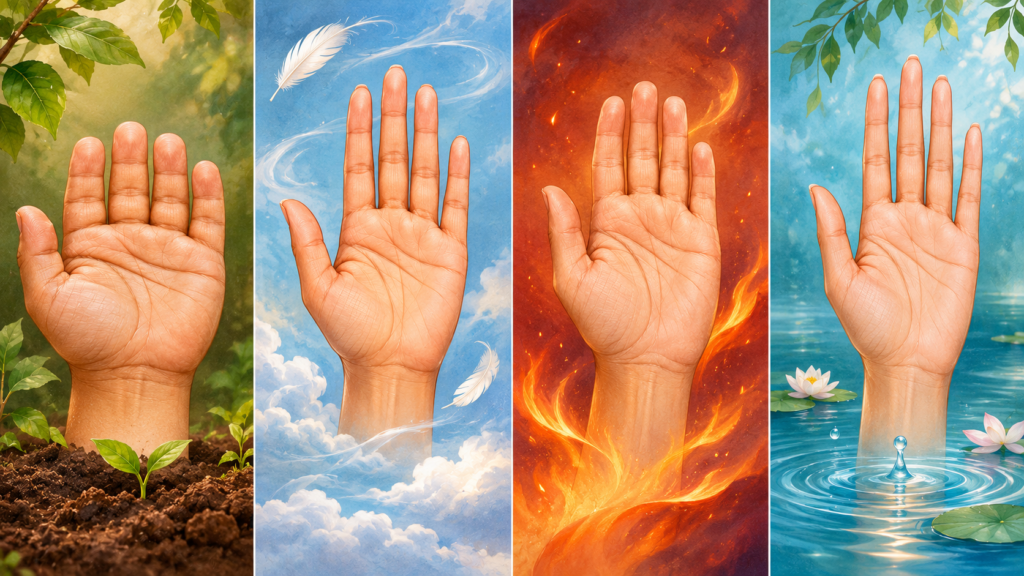
Question 5: What is a Fire hand?
Archana Bhat: A Fire hand has a rectangular palm, longer than it is wide, with short fingers. The palm often shows many lines, and the lines tend to be strong and well marked.
The Fire hand is traditionally associated with energy, enthusiasm, confidence and action. People with this type are often described as spontaneous, passionate and quick to take initiative. They are imagined as natural motivators who like a challenge and dislike sitting still.
The traditional “shadow side” of this energy is impatience. In symbolic terms, the fire that drives the Fire type forward can also burn a little too quickly.
Simple example: Think of the friend who suggests a last-minute road trip and has the car packed before everyone else has finished discussing it. That is the spirit traditionally linked with the Fire hand.
Question 6: What is a Water hand?
Archana Bhat: A Water hand has a long, rectangular palm with long, slender fingers. The palm often has many fine lines, and the skin may feel soft.
The Water hand is traditionally associated with sensitivity, imagination, intuition and emotional depth. People with this type are described as caring, artistic and perceptive. They are often linked with creative pursuits such as music, art or writing, or with caring professions.
In traditional descriptions, this sensitivity is both a gift and something to manage carefully, since a Water type is said to feel the moods of others deeply.
Question 7: How are finger length and palm proportions interpreted?
Archana Bhat: This is where you can become a little more precise. To check palm shape, measure the width of the palm across the knuckles and the length of the palm from the base of the fingers to the first wrist crease. If the two measurements are about the same, the palm is considered square. If the length is noticeably greater, it is considered rectangular.
For finger length, compare the length of the middle finger with the length of the palm. If the middle finger is roughly three-quarters of the palm length or longer, the fingers are usually considered long. If it is noticeably shorter, they are considered short.
Traditionally, longer fingers are associated with attention to detail and reflection, while shorter fingers are linked with a preference for the big picture and quicker action.
Question 8: Can one person have characteristics of more than one hand type?
Archana Bhat: Yes, and in fact most people do. Hands rarely fit neatly into one category. You might have a palm that is almost square but slightly long, or fingers that are neither clearly long nor clearly short.
In such cases, a palmist will usually say that a person has a “mixed” hand, or that one element is dominant with a touch of another. For example, someone might be described as mainly Earth with Air qualities.
This is a good reminder that the four types are a helpful framework, not boxes that people must fit into. Humans are far more interesting and varied than any classification system.
Question 9: How should beginners identify their hand shape?
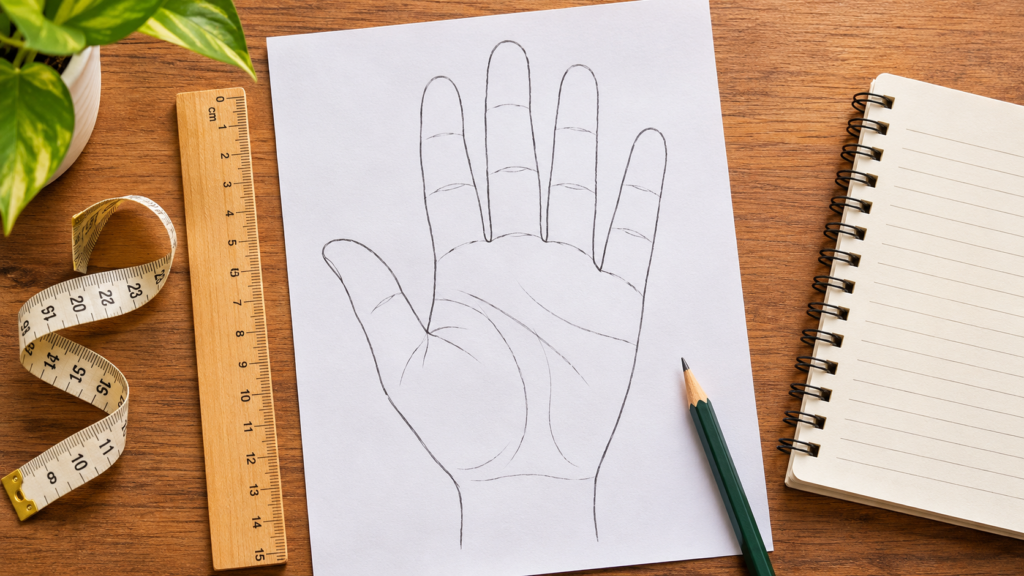
Archana Bhat: Here is a simple method you can try at home:
- Place your dominant hand flat on a sheet of paper and trace its outline lightly with a pencil.
- Measure the palm’s width and length as described above.
- Measure your middle finger and compare it with your palm length.
- Note the texture of your skin and whether your palm has a few strong lines or many fine ones.
Then compare your notes with the four descriptions. Do the same for a few family members or friends. Comparing different hands is one of the quickest ways to train your eye.
Common Myths and Misconceptions
- “Everyone fits into one hand type perfectly.” Most people have a blend of features from two types.
- “One hand type is better than another.” No hand type is superior. Each has its traditional strengths and challenges.
- “Hand shape decides your profession.” Hand type may be associated with tendencies, but it does not determine career choices or abilities.
- “The element names have astrological power.” The element names are symbolic labels to make the system easier to remember.
- “Small hands mean a small personality.” Hand size is judged in proportion to the body, and it does not measure personality.
Key Takeaways
- The four traditional hand types are Earth, Air, Fire and Water.
- They are identified by palm shape (square or rectangular) and finger length (short or long).
- Earth: practical; Air: intellectual; Fire: energetic; Water: sensitive, in traditional descriptions.
- Most people show a mix of types, and that is perfectly normal.
- Trace and measure your hand at home to identify your type.
A Closing Note from Archana
“Your hand shape is the first impression your hand makes, and it is a lovely place to begin. Have fun tracing your hand and comparing it with the people around you. Just remember that no description can capture all of who you are. In our next conversation, we will explore the seven mounts of the palm.”
About the Author
Archana Bhat is a palmistry expert who shares the traditional knowledge of hand reading in simple, accessible language for beginners and curious readers. Through “The Wisdom of Palmistry” series, she encourages readers to approach palmistry as a cultural tradition and a tool for self-reflection, never as a substitute for professional advice.
Consultations
Discover insights into your personality, strengths, relationships, career and life journey through personalised palmistry consultations.
Consultations Available In: Telugu, Hindi, Marathi & English.
🌍 Special Consultations for NRI Clients – Flexible appointment timings according to your country and time zone.
For Appointments & Enquiries:
📞 +91 8977118552
📞 +91 9082650679