Question 5: What does the middle finger represent?
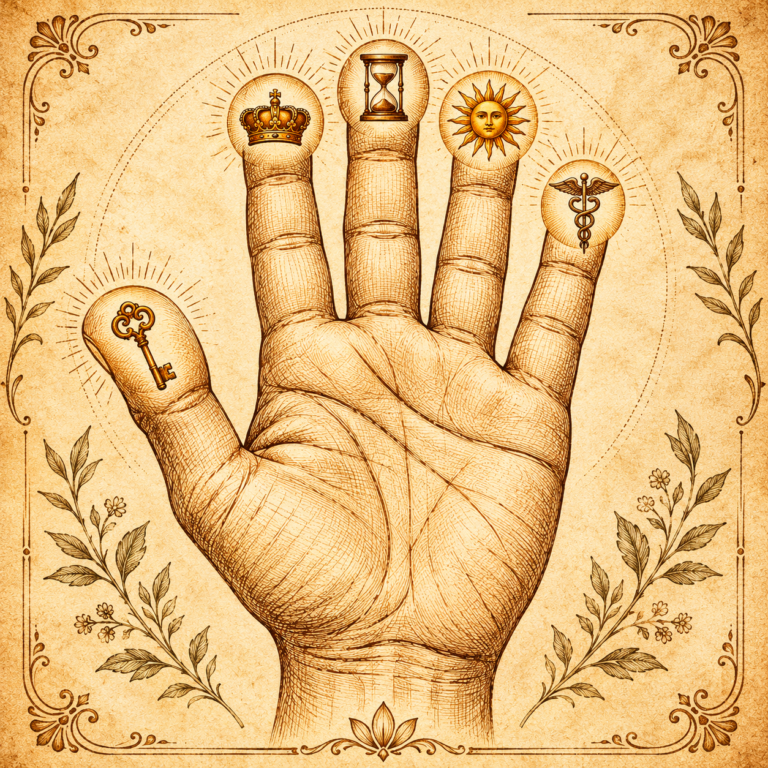
Archana Bhat: The middle finger, or Saturn finger, is the longest finger on most hands and is traditionally seen as a balance point between the personal fingers on one side and the social fingers on the other.
It is traditionally associated with responsibility, discipline, structure and a sense of right and wrong. A well-proportioned middle finger, standing straight and slightly taller than its neighbours, is often linked with a balanced and responsible nature. A very long middle finger may be associated with seriousness, while a shorter one may be linked with a more carefree attitude.
Question 6: What are the traditional associations of the ring finger?
Archana Bhat: The ring finger, or Apollo finger, is traditionally associated with creativity, artistic sense, self-expression and an appreciation of beauty. It is also linked with the desire for recognition and enjoyment of life.
A ring finger that is long and straight is often described in traditional readings as showing artistic talent and a flair for presentation. When it is longer than the index finger, it is sometimes associated with a willingness to take creative risks.
Interestingly, scientists have studied the ratio between the index and ring finger for unrelated biological reasons. That research is separate from palmistry and does not confirm palmistry’s traditional meanings, so it is best not to mix the two.
Question 7: What is the significance of the little finger?
Archana Bhat: The little finger, or Mercury finger, is traditionally associated with communication, persuasion, intellect and business sense. Despite its small size, palmists consider it a very expressive finger.
A little finger that reaches the top crease of the ring finger is traditionally considered long and is associated with excellent communication skills. A little finger that is set low on the palm, meaning its base sits noticeably lower than the other fingers, is often read as a sign of a person who may take time to gain confidence in speaking up.
Simple example: Hold your hand up with the fingers together and look at where the tip of your little finger reaches on the ring finger. It is a quick and fun observation that most people have never made before.
Question 8: Do fingertip shapes have different meanings?
Archana Bhat: Yes. Traditional palmistry describes four main fingertip shapes:
- Square tips: associated with practicality, order and a love of routine.
- Spatulate tips (wider at the top, like a spatula): associated with energy, originality and an active, inventive nature.
- Conic or rounded tips: associated with sensitivity, artistic appreciation and an intuitive approach.
- Pointed tips: associated with idealism, imagination and a dreamy, refined nature.
Many people have different tip shapes on different fingers, which traditional palmists see as adding variety and balance. Fingernails and the natural padding of the fingertips can affect how the shape appears, so look carefully and in good light.
Question 9: Can finger proportions influence the overall interpretation of a hand?
Archana Bhat: Very much so. As we discussed in our conversation on hand types, the length of the fingers compared with the palm is one of the main ways palmists identify Earth, Air, Fire and Water hands.
The three sections of each finger also matter. Traditionally, the top section is linked with mental and spiritual matters, the middle section with practical matters and the lowest section with material and physical matters. If one section looks noticeably longer or fuller, that area of life is traditionally said to be emphasised.
Knotty knuckles, smooth fingers, wide gaps between fingers when the hand is relaxed: all of these add further traditional detail. The key is to treat them as small brushstrokes in a larger picture, not as separate verdicts.
Common Myths and Misconceptions
- “A short thumb means a weak person.” Thumb length is traditionally associated with style of determination, not strength of character.
- “Long fingers mean you are artistic.” Finger length is only one of many traditional features, and talent comes from practice and interest.
- “A crooked finger is a bad sign.” Fingers may be shaped by injury, joints or work, which have nothing to do with symbolism.
- “Everyone’s fingertips are the same shape.” Fingertip shapes often differ from finger to finger on the same hand.
- “The finger ratio studied by science proves palmistry.” That research is separate and does not validate palmistry’s traditional meanings.
Key Takeaways
- Each finger shares the symbolism of the mount below it: Jupiter, Saturn, Apollo and Mercury.
- The thumb is traditionally linked with willpower and logic; its flexibility with adaptability.
- Index finger: leadership; middle finger: responsibility; ring finger: creativity; little finger: communication.
- Fingertip shapes (square, spatulate, conic, pointed) add traditional nuance.
- Finger proportions and sections must be read together with the whole hand.
A Closing Note from Archana
“The next time you hold a cup or write a note, take a moment to notice your fingers. They carry so much of who we are and what we do every day. Explore their shapes with curiosity and kindness. In our next conversation, we will look at some of the more unusual signs you may find on the palm: stars, crosses, triangles and more.”
About the Author
Archana Bhat is a palmistry expert who shares the traditional knowledge of hand reading in simple, accessible language for beginners and curious readers. Through “The Wisdom of Palmistry” series, she encourages readers to approach palmistry as a cultural tradition and a tool for self-reflection, never as a substitute for professional advice.
Consultations
Discover insights into your personality, strengths, relationships, career and life journey through personalised palmistry consultations.
Consultations Available In: Telugu, Hindi, Marathi & English.
🌍 Special Consultations for NRI Clients – Flexible appointment timings according to your country and time zone.
For Appointments & Enquiries:
📞 +91 8977118552
📞 +91 9082650679