The Mayan Civilization: A Brief Overview
The Maya civilization flourished across present-day Mexico, Guatemala, Belize, Honduras, and El Salvador, reaching its peak between 250 and 900 A.D. Known for their advanced knowledge of astronomy, mathematics, and intricate writing system, the Maya left behind incredible cities, with Tikal being one of the most impressive.
At its height, Tikal was a bustling city-state and a vital center of politics, culture, and trade. Its population may have reached over 100,000, and its influence stretched far across the region. However, like many other Mayan cities, Tikal was mysteriously abandoned around the 9th century, leaving behind questions that continue to puzzle historians and archaeologists.
Discovering Tikal: A Journey Through Time
The modern world first learned of Tikal’s existence in the 1840s when European explorers stumbled upon its towering temples hidden beneath centuries of jungle overgrowth. However, it wasn’t until 1877 that the site gained more attention. During that year, several pieces, including parts of Temple I, were looted from the site’s major temples.
In 1881–1882, Alfred P. Maudslay, a British archaeologist, created the first detailed map of Tikal’s central area. He identified five major temples, labeling them alphabetically from A to E. Among them, Temple I and Temple IV are especially iconic, often dominating photographs of the site. Maudslay’s work paved the way for future exploration and restoration, transforming Tikal into the archaeological treasure we know today.
Exploring the Mayan Temples of Tikal
Tikal’s temples are more than just towering structures; they are spiritual and ceremonial hubs that reflect the Mayans’ sophisticated society. Each temple tells a story of rulers, rituals, and cosmic connections.
Temple I: The Temple of the Great Jaguar
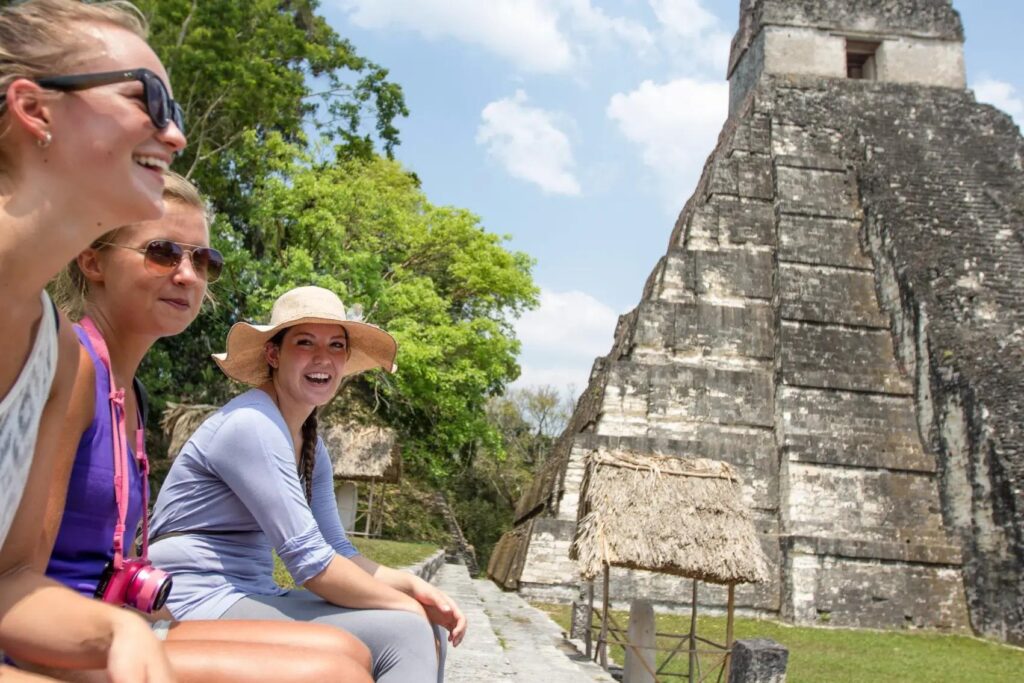
- Rising 47 meters (154 feet) above the jungle, Temple I is one of Tikal’s most recognizable landmarks.
- This pyramid was built around 732 A.D. as the tomb of Jasaw Chan K’awiil I, a prominent Tikal ruler.
- Its steep steps lead to a small shrine at the top, which likely hosted ceremonies to honor the gods and the deceased king.
Temple II: The Temple of the Masks
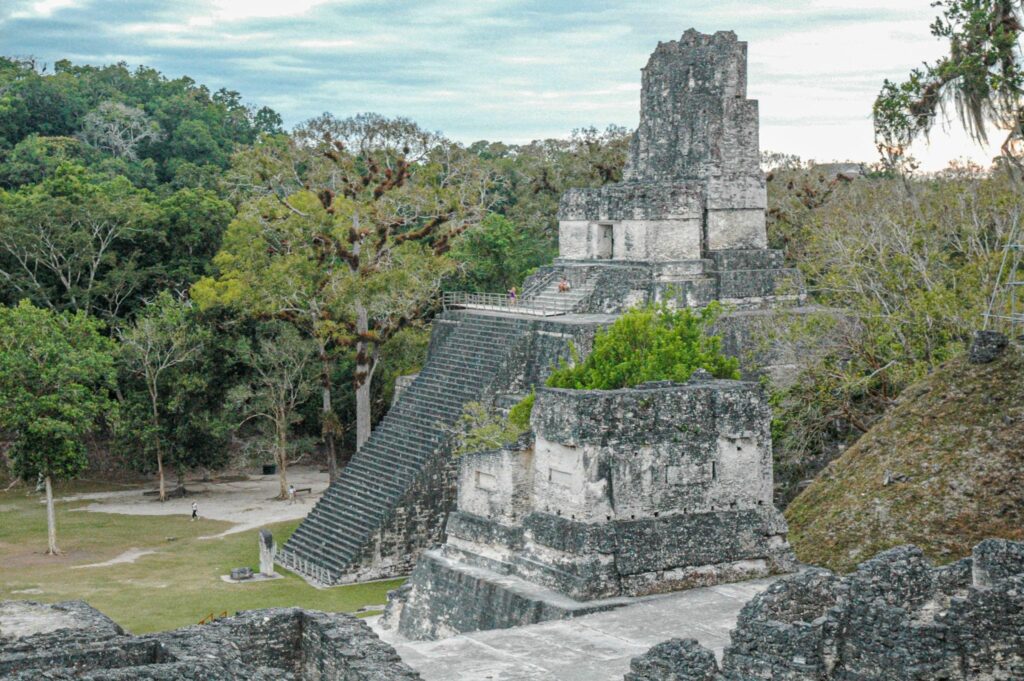
- Located opposite Temple I in the Great Plaza, Temple II was constructed in honor of Jasaw Chan K’awiil’s wife.
- Slightly shorter than Temple I, it still offers a breathtaking view of the surrounding jungle.
Temple IV: The Temple of the Two-Headed Serpent
- At 70 meters (230 feet), Temple IV is the tallest structure in Tikal and one of the tallest pre-Columbian buildings in the Americas.
- Climbing to its summit offers an unparalleled panoramic view, where the tops of other temples rise like islands above the sea of green jungle.
Temple V
- Temple V is the second-highest structure in Tikal, standing at 57 meters (187 feet).
- Its function remains a mystery, though it is believed to have been built around 700 A.D.
Temple VI: The Temple of the Inscriptions
- Known for its elaborate hieroglyphic panels, Temple VI provides insights into Tikal’s history and the Mayan calendar.
The Mystery of the Maya
Despite extensive research, the Mayan civilization remains shrouded in mystery. Among the most perplexing questions are:
- Why Did They Abandon Their Cities?
- Tikal, like many Mayan cities, was abandoned around the 9th century. Theories range from environmental degradation and resource depletion to warfare and political collapse. However, no single explanation fully accounts for their sudden decline.
- What Do the Temples Symbolize?
- The temples were not just architectural feats but also symbolic representations of the Mayan worldview. Their alignment with celestial events suggests a deep connection to astronomy, while their steep designs might have symbolized mountains or a bridge between the earthly and divine realms.
- What Happened to Their Knowledge?
- The Mayans possessed advanced knowledge of astronomy, mathematics, and architecture, much of which remains a source of fascination. Their written records, inscribed on stelae and codices, hint at a sophisticated understanding of time and cosmology that we are still deciphering today.
Special Attractions of Tikal
Tikal offers more than just a history lesson; it’s an immersive experience that blends natural beauty with ancient wonder.
- Jungle Setting
- Surrounded by the lush rainforests of Guatemala, Tikal is home to diverse wildlife, including howler monkeys, toucans, and jaguars. The symphony of jungle sounds adds to the site’s mystical atmosphere.
- Star Wars Connection
- Temple IV famously appeared in Star Wars: A New Hope as the rebel base on Yavin 4. Fans of the franchise will recognize its iconic silhouette.
- Sunrise and Sunset Views
- Climbing to the top of a temple to watch the sunrise or sunset is an unforgettable experience, as the golden light bathes the ruins and jungle canopy in ethereal hues.
- Mayan Astronomy
- The Mayans were skilled astronomers, and Tikal’s layout reflects their celestial knowledge. Many of the temples align with solstices and equinoxes, creating a spiritual and astronomical connection.
Visiting Tikal: Tips for Travelers
- Best Time to Visit: The dry season (November to April) offers the most comfortable weather for exploring.
- Guided Tours: Hiring a guide can enrich your visit with detailed explanations of the site’s history and significance.
- Stay Overnight: Staying in the nearby town of Flores allows for an early morning visit, when the site is less crowded and the wildlife is more active.
- Bring Essentials: Comfortable walking shoes, water, sunscreen, and bug repellent are must-haves for a day at Tikal.