The Retailer’s Growth Partner: Why Choosing the Right Distributor Matters
Ask any successful two-wheeler spare-parts shop owner what really made their business grow. Most people expect the answer to be “a good location” or “lots of customers.” Th

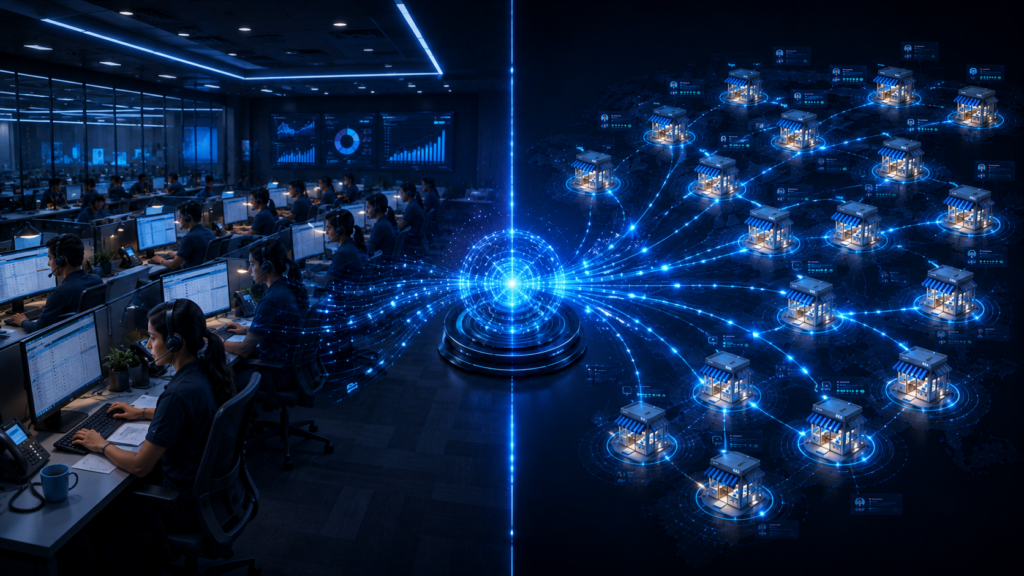
Most distributors evaluating AI telecalling are not starting from zero. They already have a calling function — sometimes a formal team, more often a handful of people who make follow-up calls between other responsibilities. The question is not whether to start calling retailers. It is whether the calling should continue to be done entirely by people.
That question deserves a fair comparison rather than a sales pitch. Human telecalling has genuine advantages that no honest assessment should ignore. This article sets out where each approach is stronger, and how distributors should actually decide.
Before discussing limitations, it is worth being clear about what a good human telecaller brings that software does not.
When a retailer explains that their own customer has delayed payment, that a family situation has affected the business, or that a competing distributor has offered better terms, a skilled telecaller reads the subtext and adapts. They know when to press, when to offer flexibility and when to hand the conversation upward. That judgement is genuinely difficult to replicate.
In distribution, the relationship between a distributor’s staff and a retail outlet often spans years. A telecaller who knows the shop owner’s name, remembers the last conversation and asks after the business is doing something commercially valuable that goes beyond the immediate collection.
Complex settlements — part payments, extended terms, dispute resolution, supply decisions — require a person with authority to make commitments on behalf of the distributor.
A human being can absorb an unusual situation, improvise, and route it correctly. Software handles what it was designed to handle.
The limitations are structural rather than a matter of effort or competence.
A telecaller can hold roughly forty to sixty meaningful conversations in a working day. Covering a network of two thousand retailers on a fortnightly cycle therefore requires a team, and doubling the network requires doubling the team. Collections cost scales directly with network size.
Tone, persistence and script adherence vary by person, by day and by workload. The eleventh call of the morning is rarely conducted with the same energy as the first. This is human, not a criticism — but it means the retailer experience is uneven.
What was committed, by whom and for when gets recorded only if the telecaller logs it, and logging is the first thing to slip when call volume rises. Commitments end up in notebooks and messaging threads.
When time is scarce, teams work top-down by outstanding amount. Hundreds of smaller accounts never get contacted, not because they are unimportant in aggregate but because each individually does not justify a call.
Telecalling roles have high turnover. When an experienced caller leaves, the relationship history and account knowledge they held is usually not recoverable.
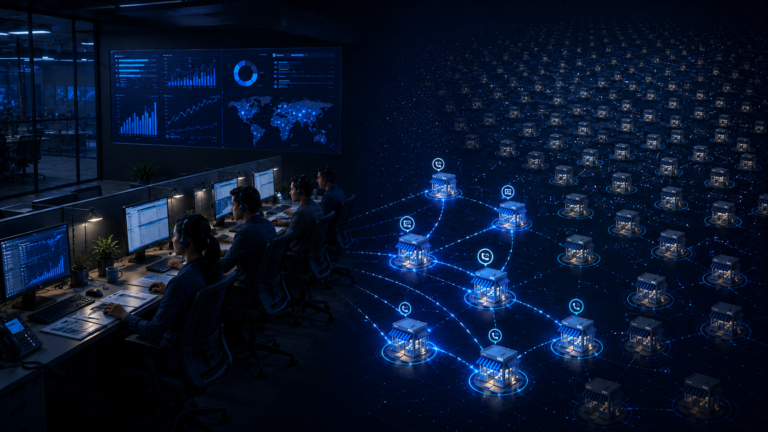
The number of conversations an AI agent can hold in a day is not bounded by headcount. Contacting two thousand retailers is operationally similar to contacting two hundred. This is the single most important difference between the two models.
Every call follows the same structure, with the same clarity and the same professionalism, regardless of time of day or call volume. Retailers receive consistent treatment, which over time reinforces what the distributor’s terms actually mean.
Because the system conducts the conversation, it also records it. Commitments become structured data — amount, date, reason — rather than notes someone may or may not have written down. That makes receipts forecastable.
When the marginal cost of an additional conversation is low, contacting a small-balance account becomes rational. Coverage extends across the whole ledger rather than the top of it.
Follow-up on a committed date happens without fail. No account is forgotten because the person handling it was on leave.
An honest assessment has to include the limitations, and distributors should be sceptical of vendors who present none.
Wrong phone numbers, duplicate ledgers and inconsistent outlet names will degrade an AI programme faster than they degrade a human one, because a person can improvise around bad data and software cannot. Distributors with poorly maintained retailer master data should expect to invest real effort in cleanup first.
A structured conversation about an outstanding invoice is well within scope. A multi-invoice settlement involving disputed quantities, damaged goods and a supply decision is not, and should be escalated.
An AI agent conducts a transaction. The commercial relationship between distributor and retailer is still built by people, in person, over time.
Performance across Indian languages and regional accents differs considerably between platforms. This should be tested on the distributor’s own retailer base before commitment, not accepted on the basis of a demonstration.
The question is not whether an AI agent can replace a telecaller. It is which part of the calling workload should have been automated all along. |
Dimension | Traditional Telecalling | AI Telecalling |
|---|---|---|
Capacity | Fixed by headcount | Elastic across the network |
Cost behaviour | Scales with retailer count | Largely decoupled from retailer count |
Consistency | Varies by person and workload | Uniform across every call |
Record keeping | Depends on individual discipline | Structured and automatic |
Long-tail coverage | Rarely economical | Economically viable |
Complex negotiation | Strong | Requires escalation to a person |
Relationship building | Strong | Not the objective |
Data quality dependence | Moderate | High |
Persistence on follow-up | Inconsistent | Reliable |
Framing this as a choice between two options is the mistake most evaluations make. The workload is not homogeneous, and it should not be handled by a single mechanism.
A practical split looks like this:
In this model the calling team does not shrink into irrelevance. It moves up the value chain, spending its time on the conversations where judgement actually changes the outcome, supported by a complete record of what the AI agent has already attempted.

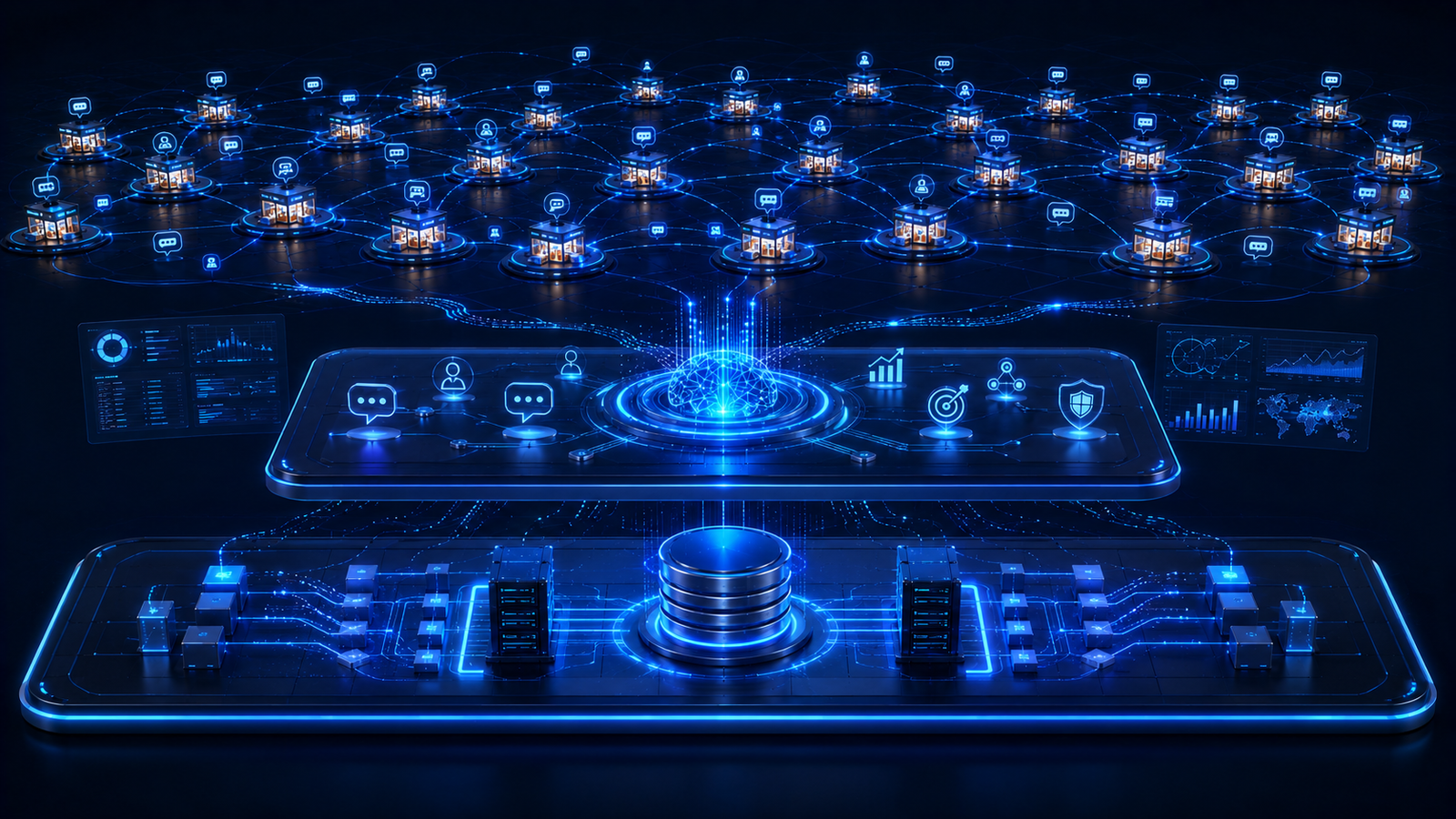
RIA is built on the assumption that the human layer stays. The platform runs the retailer data through an intelligence layer, decides which accounts warrant a conversation and what the objective of that conversation should be, conducts the call in the retailer’s own language, captures the commitment as structured data, and returns on schedule.
What it deliberately does not do is decide the credit policy, negotiate a settlement, or take a supply decision. Those route to a person, with the full conversation history attached so that the escalation starts informed rather than from scratch. The escalation thresholds themselves are configured by the distributor, not by the platform.
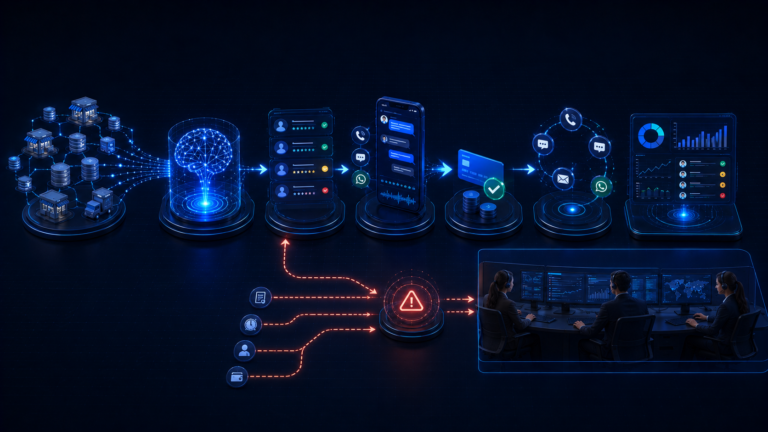
Distributors moving to a hybrid model tend to follow a similar path, and the sequence matters more than the speed.
The most sensible first deployment is the segment of the ledger that receives no attention at all — typically the long tail of small balances that has never justified a dedicated call. Coverage there is currently nil, so there is very little downside, and it produces a realistic picture of conversation quality across a genuine cross-section of the retailer base.
During the transition, the calling team should continue handling the accounts they know. Removing them from the process before the automated layer has proven itself creates a gap that is difficult to recover from, and it wastes the relationship knowledge they hold.
The single most common implementation failure is not having decided who picks up an escalated account, how quickly, and what they are authorised to offer. Without that, difficult accounts loop through automated contact indefinitely and the retailer’s frustration compounds.
Call counts are the easiest metric and the least informative. What matters is what proportion of contacted accounts produced a specific commitment, and what proportion of those commitments were honoured. Those two numbers tell a distributor whether the programme is working.
The teams that get the most from this shift are the ones redeployed onto the escalation queue, dispute resolution and relationship-building visits — work that was previously squeezed out by routine dialling. Treating the technology purely as a cost-reduction exercise usually leaves the larger benefit on the table.
Distributors are often most anxious about how retailers will respond, and the concern deserves a direct answer rather than reassurance.
In practice, retailer acceptance depends far more on call design than on the fact of automation. Calls that are short, that identify the distributor immediately, that reference a specific invoice and amount, and that accept a range of responses gracefully are generally received as businesslike. Calls that are long, vague, or that attempt to simulate a human conversation tend to irritate.
The second factor is frequency. A retailer contacted once about a genuinely overdue invoice will engage. The same retailer contacted four times in a week will disengage entirely, and will carry that impression into every subsequent interaction with the distributor. Frequency caps are not a technical nicety; they are the difference between a programme that works and one that damages the network.
Rather than comparing feature lists, distributors should answer four questions about their own business.

AI telecalling and traditional telecalling are not competing answers to the same question. They are suited to different parts of the same workload. Human callers are irreplaceable for judgement, negotiation and relationship depth. AI agents are unmatched for coverage, consistency, persistence and record keeping.
The distributors who get the most from this technology will not be the ones who replace their calling teams. They will be the ones who use it to finally cover the accounts they could never reach, capture the commitments they could never track, and free their people to do the work that actually required a person in the first place.






Ask any successful two-wheeler spare-parts shop owner what really made their business grow. Most people expect the answer to be “a good location” or “lots of customers.” Th
Hyderabad, September 13, 2026:The National Consumer Rights Commission (NCRC), Telangana, conducted a two-day voluntary Consumer Food Safety & Hygiene Inspection Initiative acro
Distribution software has historically been built to record. Orders, invoices, stock movements, receipts — the systems that run distribution businesses are, at their core, extrem
Predictions about the future of any industry tend to be either too timid or too fanciful. The useful version sits in between: identify what is structurally constrained today, ident
Every distributor knows what needs to happen after a retailer says “I will pay on the fifteenth”. Someone should check on the fifteenth. In practice, in most distributi
"Enjoyed this post? Don’t miss out on future updates – subscribe now to stay inspired and informed!"