The Retailer’s Growth Partner: Why Choosing the Right Distributor Matters
Ask any successful two-wheeler spare-parts shop owner what really made their business grow. Most people expect the answer to be “a good location” or “lots of customers.” Th


Every distributor knows what needs to happen after a retailer says “I will pay on the fifteenth”. Someone should check on the fifteenth. In practice, in most distribution businesses, nobody does — not through negligence, but because by the fifteenth that conversation is one of several hundred that have taken place since, and the person who had it is dealing with today’s urgent problems rather than last week’s commitments.
Follow-up, not the initial contact, is where distribution collection processes actually break. This article examines why, because the reasons are structural and understanding them is a prerequisite to fixing anything.
The two are usually discussed together and should not be. Making an initial contact is a single, self-contained action. Follow-up is a commitment to return at a future point, with memory of what happened previously, across a large number of parallel threads.
Consider the difference in operational demands:
That last asymmetry matters enormously. A distributor can see that a retailer was never called. They cannot easily see that a retailer who committed to pay was never checked on. The failure leaves no trace until it appears in the ageing report weeks later.
Follow-up is the first thing to collapse when a collections function comes under pressure, and it collapses for predictable reasons.
A fresh escalation from the owner, a retailer who has called in angry, a large account that has just crossed sixty days — these compete for attention against a routine check on a commitment made ten days ago. The routine check loses every time, even though it is often the more productive use of the hour.
Where commitments are recorded in notebooks, messaging threads or memory, the follow-up schedule exists only in the mind of the person who took the commitment. It cannot be reassigned, monitored or covered during leave.
A telecaller handling fifty conversations a day accumulates roughly a thousand commitments a month. No person can hold that reliably. Some will be remembered because the account was memorable; most will not.
When someone leaves a calling or field role, every commitment they were holding informally disappears with them. The distributor does not know what was promised, by whom, or for when.

Distribution collection rarely resolves on the first conversation. A reminder produces a commitment; the commitment produces payment only if it is honoured, and honouring is materially more likely when the retailer knows a follow-up is coming.
When the second contact does not happen, several things follow.
The compounding effect is the important part. A commitment that lapses without follow-up does not stay at the same level of difficulty. It becomes a larger balance, an older invoice and a more defensive counterparty.
The call that never gets made is the one nobody notices was missing. |
It is worth widening the frame briefly. Collections is the most visible follow-up failure in distribution, but it is not the only one.
The common structure across all of these is identical: a first contact happened, a return was required, and the return depended on human memory and available time. That is why follow-up, treated as a general capability rather than a collections-specific task, is one of the most consequential problems in distribution.
Distributors have tried to fix follow-up with process for a long time. Daily review meetings, follow-up registers, CRM entries, WhatsApp groups for the sales team. These help at the margin and none of them solve it, for a straightforward reason.
Every one of those mechanisms adds work to the same constrained resource. A follow-up register only works if someone maintains it; a CRM only works if someone enters the data; a review meeting only works if someone prepares for it. When the underlying capacity problem is that there are more conversations required than there are hours available, adding administrative overhead to those hours makes the constraint worse, not better.
The only solutions that have ever worked in practice are ones that reduce the amount of human effort required per follow-up — and until recently, no such solution existed.
An intelligent collection layer changes the economics of the second, third and fourth contact.
None of these steps is intellectually sophisticated. Their value lies entirely in the fact that they happen every time, across the whole network, regardless of workload, leave or attrition.
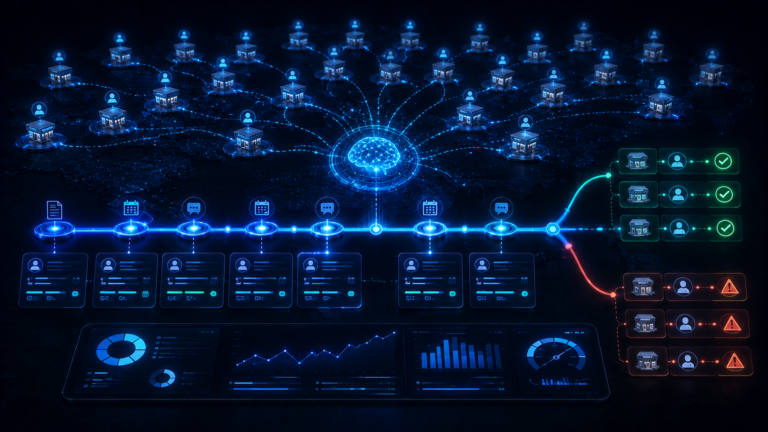
Not all follow-up is equally effective, and distributors who systematise it should also improve its design. Four characteristics separate a productive second contact from a wasted one.
“You mentioned you would clear eighty thousand on the fifteenth” is a materially different opening from “your payment is still pending”. The first establishes that the distributor was listening and is keeping records. The second is indistinguishable from a generic reminder and carries no weight.
Chasing a retailer for money they have already paid is one of the fastest ways to damage credibility across a network. Any follow-up mechanism, manual or automated, must verify receipt before contacting.
A first contact seeks a commitment. A follow-up on a missed commitment seeks two things: an explanation and a revised commitment. Treating the second call as a repeat of the first wastes the conversation and irritates the retailer.
A follow-up two days before the committed date acts as a helpful confirmation. The same call two weeks after the date has passed is a recovery conversation with a defensive counterparty. The interval matters more than the effort.
There is a use for follow-up data that distributors rarely exploit, and it may be more valuable than the immediate cash recovery.
When honoured and broken commitments are recorded consistently over several months, each retailer develops a documented reliability profile. That profile is a considerably better predictor of credit risk than outstanding balance or ageing alone, because it measures behaviour rather than position.
None of these signals are visible in an ageing report. All of them emerge from follow-up data, and only if that data is captured in a structured, comparable form across the network. This is the argument for systematising follow-up that has nothing to do with efficiency.
RIA is designed around the view that follow-up, rather than first contact, is the operationally difficult part of collections.
The intent is not to make follow-up faster. It is to make it unconditional — something that happens because it is scheduled, not because someone remembered.
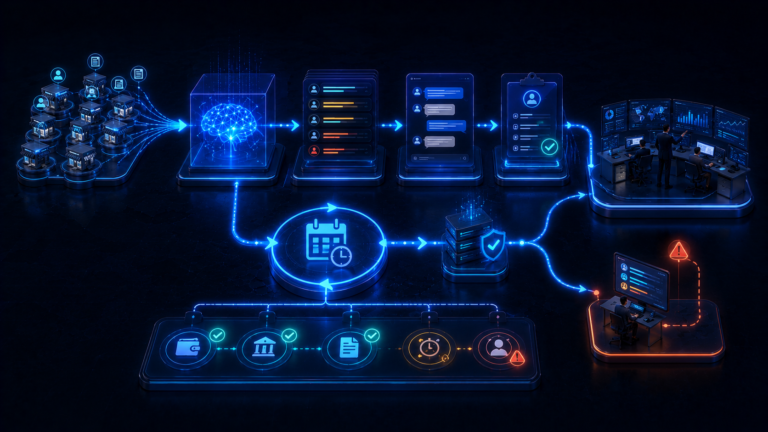
Distributors who make follow-up systematic tend to see change in a particular order.
The magnitude of these effects depends on the distributor’s category, terms and retailer mix. The direction is consistent, because the mechanism being fixed — the missed second contact — is common to almost every distribution business.

Retailer follow-up is difficult not because distributors do not understand its importance, but because it demands sustained parallel attention across hundreds of threads while new work arrives continuously. No amount of process discipline overcomes that arithmetic.
What changes the arithmetic is removing the human effort required per follow-up, so that returning to a commitment costs almost nothing and therefore always happens. That is a narrow capability with disproportionate consequences: it closes the specific gap where most distribution collection value is currently lost, and it does so without requiring anyone to remember anything.






Ask any successful two-wheeler spare-parts shop owner what really made their business grow. Most people expect the answer to be “a good location” or “lots of customers.” Th
Hyderabad, September 13, 2026:The National Consumer Rights Commission (NCRC), Telangana, conducted a two-day voluntary Consumer Food Safety & Hygiene Inspection Initiative acro
Distribution software has historically been built to record. Orders, invoices, stock movements, receipts — the systems that run distribution businesses are, at their core, extrem
Predictions about the future of any industry tend to be either too timid or too fanciful. The useful version sits in between: identify what is structurally constrained today, ident
Every distributor knows what needs to happen after a retailer says “I will pay on the fifteenth”. Someone should check on the fifteenth. In practice, in most distributi
"Enjoyed this post? Don’t miss out on future updates – subscribe now to stay inspired and informed!"