The Retailer’s Growth Partner: Why Choosing the Right Distributor Matters
Ask any successful two-wheeler spare-parts shop owner what really made their business grow. Most people expect the answer to be “a good location” or “lots of customers.” Th


Most explanations of AI collection software stay at the level of capability — it calls retailers, it captures commitments, it follows up. That is accurate and not especially useful to a distributor trying to work out whether it will fit their operation.
This article does the opposite. It follows a single overdue invoice through the RIA Collection Agent from the moment it enters the system to the moment the payment is reconciled, and states plainly what happens at each step, what the distributor controls, and where a human being takes over.
Nothing in a collection system works without a reliable view of what is outstanding, and that view lives in the distributor’s accounting package rather than in the collection platform.
RIA is built to read from the systems distributors already run. In the Indian distribution market that typically means a structured import from packages such as Marg, Tally or Busy. The import brings across the information the intelligence layer needs:
A deliberate design decision here is that the distributor should never maintain a second set of records. The accounting package remains the source of truth. RIA reads from it, acts on it, and writes outcomes back in a form the distributor can reconcile.
It is worth being direct about a dependency at this stage: the quality of the retailer master data determines how well everything downstream performs. Duplicate ledgers, outdated phone numbers and inconsistent outlet naming are the most common reasons a collection programme underperforms, and they are worth resolving before go-live rather than discovering afterwards.
Each cycle begins with a decision rather than a call. Given the current outstanding position across the entire retailer ledger, which accounts warrant contact today, and what should the objective of each contact be?
The prioritisation considers several dimensions together:
The output is not simply a list sorted by amount. It is a working set where each account carries a defined objective — a first reminder, a follow-up on a commitment approaching its date, a check on a commitment that has passed, or a re-engagement of an account that has gone quiet.

With the objective set, the agent places the call. Three things govern how that conversation goes.
The call is conducted in the language the retailer is most comfortable speaking. In a typical south Indian distributor’s network this may span Telugu, Tamil, Kannada, Hindi and English across a single territory. This is not a convenience feature — a collection conversation requires precision about amounts and dates, and precision degrades quickly when the retailer is operating in a second language.
The conversation is short and purposeful. The agent identifies itself and the distributor immediately, states the specific invoice and outstanding amount rather than speaking in generalities, asks a direct question about payment, and then listens. It is designed to be useful rather than to sound human.
A real collection call does not have one outcome. The agent is built to handle the responses that actually occur:
Each of these produces a different next action, which is the point. A system that can only record “called, no payment” is not materially better than a spreadsheet.
This step is where most of the long-term value sits, and it is the step manual processes almost always lose.
When a retailer commits, RIA converts the spoken response into structured fields: the committed amount, the committed date, and the stated reason where one is given. Disputes are captured as flagged records with the nature of the dispute attached. Callback requests carry a time.
The significance is that these records aggregate. Across a network, they become a forward view of expected receipts — what is committed, from whom, for when — rather than a backward log of calls made. A distributor can look at the month ahead and see a schedule rather than an estimate.
A call recording tells you what was said. A structured commitment tells you what to expect. |
A commitment without follow-up is an intention. RIA returns automatically at the points where manual processes typically lose money.
This persistence, applied uniformly across the entire network without depending on anyone’s memory or availability, is the most operationally significant thing the system does.
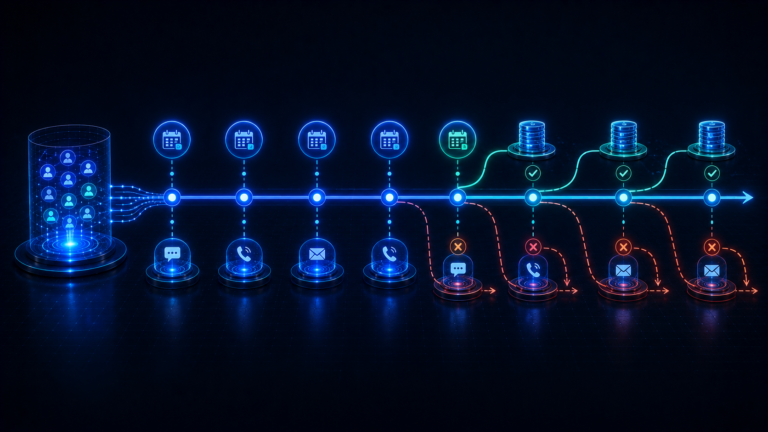
RIA is explicitly not designed to handle everything. Certain situations should reach a person, and the platform’s job is to route them there with full context rather than to persist.
When an account escalates, the person picking it up receives the full history — every contact attempt, every response, every commitment made and broken. The escalation starts informed rather than from scratch, which is a meaningful difference from how most escalations currently work.
Critically, the thresholds that trigger escalation are configured by the distributor. So are calling windows, contact frequency caps, and the tone applied to different retailer segments. RIA executes a policy; the distributor sets it.
Every interaction updates the collection position, so the distributor sees a live picture rather than a month-end reconciliation.
Over time the reliability data becomes the most useful output, because it converts a soft judgement about which retailers are dependable into a documented pattern.

A recurring concern when distributors first evaluate this workflow is how much of their credit process they are handing over. The answer is: none of the decisions, all of the execution.
These settings are where a collection programme is actually tuned. Two distributors running the same platform with different configurations will produce very different retailer experiences, and the configuration should reflect the distributor’s own commercial judgement rather than a vendor default.
Distributors planning adoption should expect the work to be weighted toward preparation rather than deployment.
The temptation to compress this by launching across the full network in the first month is understandable and usually counterproductive. A configuration that has not been tested on a real cross-section of the retailer base will produce avoidable friction with the accounts a distributor can least afford to irritate.
The practical effect of running this workflow is a change in what the collections function is.
What it does not change is who owns the relationship or who sets the terms. Those remain firmly with the distributor, which is the correct place for them.

The path from invoice to payment in a distribution business has always involved the same steps: know what is outstanding, decide who to contact, have the conversation, record what was agreed, follow up, and escalate what needs a person. None of that is new.
What RIA changes is that these steps happen consistently across the entire retailer network rather than across whichever portion of it there was time for. The workflow is not more sophisticated than what a well-run collections team does. It is simply able to do it everywhere, every time, and to keep the record.






Ask any successful two-wheeler spare-parts shop owner what really made their business grow. Most people expect the answer to be “a good location” or “lots of customers.” Th
Hyderabad, September 13, 2026:The National Consumer Rights Commission (NCRC), Telangana, conducted a two-day voluntary Consumer Food Safety & Hygiene Inspection Initiative acro
Distribution software has historically been built to record. Orders, invoices, stock movements, receipts — the systems that run distribution businesses are, at their core, extrem
Predictions about the future of any industry tend to be either too timid or too fanciful. The useful version sits in between: identify what is structurally constrained today, ident
Every distributor knows what needs to happen after a retailer says “I will pay on the fifteenth”. Someone should check on the fifteenth. In practice, in most distributi
"Enjoyed this post? Don’t miss out on future updates – subscribe now to stay inspired and informed!"